Chatbot
Arty is the name of our AI-based assistant, with which you can interact through the chatbot and is specialized in real-time consulting. Within the chatbot, you can ask Arty your questions and receive an automated response in no time. For example, you can get assistance with using features in BIC Process Design or ask questions about your published processes.

To use the chatbot, all that is required is to activate the necessary license. After that, all users will find the Chatbot menu item in the left menu bar and can interact with the chatbot.

Hint
Please note that a separate license is required to use this feature. Also, please refer to the guidelines for using the AI feature.
How does the chatbot work?
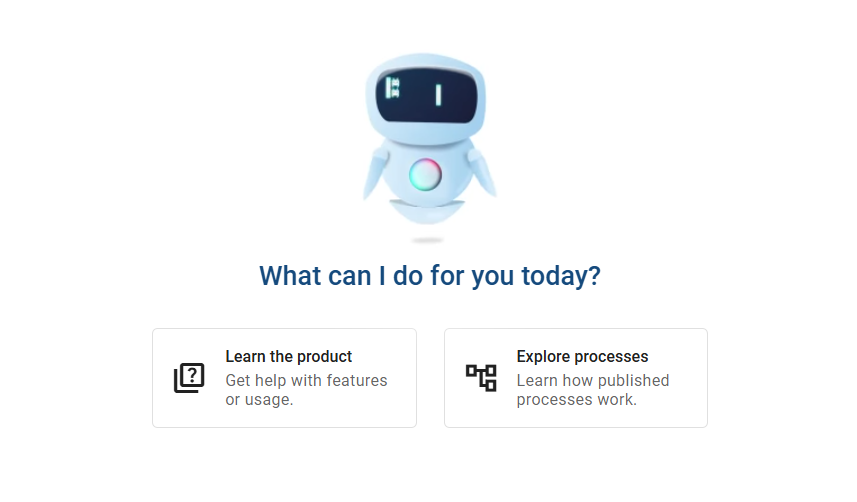
When you click on the Chatbot menu item in the left menu bar, the chatbot will open. You will be greeted by our AI-based assistant, Arty, in your browser’s language. Below the greeting, you will find two different options to help you get more specific answers to your questions. These options are as follows:
Learn the product: If you select the Learn the product option, you can ask questions about the features of BIC Process Design. The online documentation, which is also referenced as a hyperlink when you receive an answer from Arty, is used as the data source for the response.
Explore processes: If you select the Explore processes option, you can ask questions about your published processes in BIC Process Design. Only the modeled data from the Publication stage will be used as the data source, and the published processes referenced are linked in the answer. If you click on a linked process, you will be redirected to the corresponding diagram in the Publication stage.
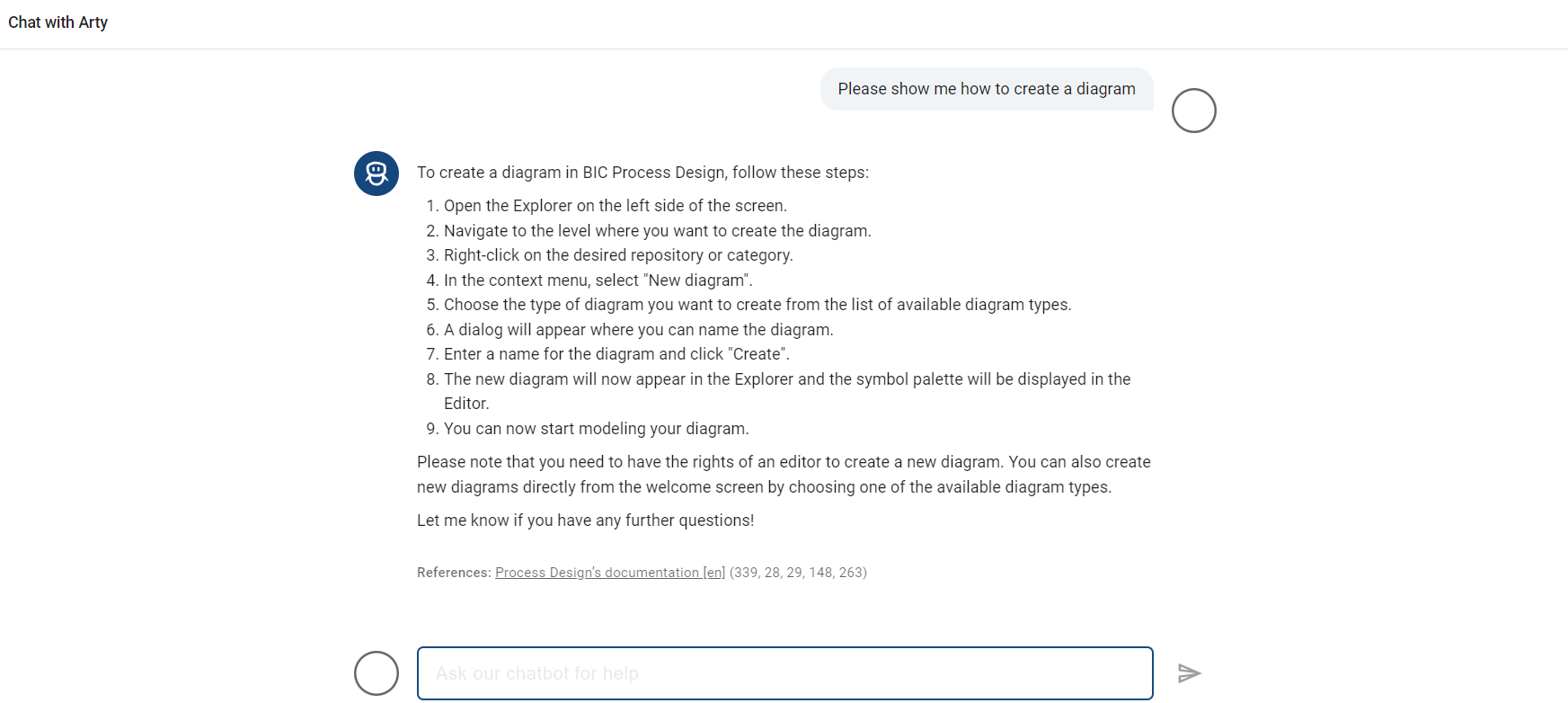
After selecting an option, you can enter your question in the input field. Once you have entered at least one character in the input field, the send option will be enabled. You can send your question to Arty by clicking the Send button to the right of the input field or by pressing the Enter key. Within a few moments, you will receive an answer to your question.
Hint
Please note that the input field is limited to 1024 characters. A counter at the bottom right of the input field shows how many characters you have entered. Once the limit is reached, further input is blocked and no additional characters are accepted.
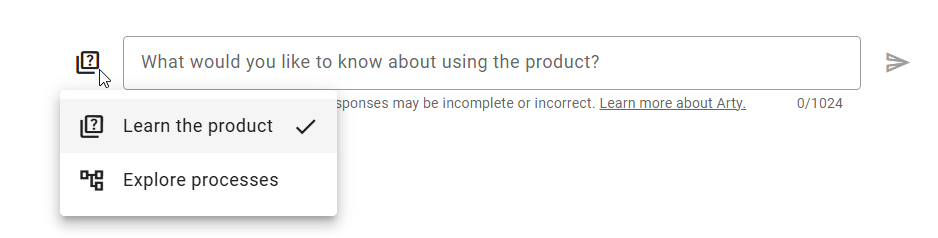
If you want to ask a question about a different option at a later time, click the icon to the left of the input field that shows the icon of the currently selected option.
Hint
Please note that your chat history will be deleted after changing the option.
You also have the option to learn more about Arty. To do this, click the link below the input field. The documentation with notes on the use of AI features will open in a new tab.
Is the chat history saved during the session?
During an active session, the chat history is retained and extended with each new message. Your inputs are taken into account, allowing the chatbot to refer to previous messages in context and create a coherent dialog.
You can start a new conversation by clicking the New Chat button or by switching to the knowledge base. The previous chat history remains visible but is no longer included in the new conversation.

As long as the session is active, the current chat remains intact, even if you exit the application and return later. Once the session ends, the chat history is deleted.
Hint
The knowledge base you are currently in is displayed in the chat input field.
Tip
It can be helpful to reset the chat history when starting questions on a new topic. This helps to avoid influence from previous context and can improve the clarity and accuracy of the answers.
How can I open references in the chatbot?
To view references to questions asked about published processes and navigate to them, open the Chatbot menu item in the left menu bar and ask a question. If the answer contains references, a section is displayed below the answer. This section is always open and shows all available references.
References can have different types, for example diagrams, objects, or search results. Each reference is shown with a matching icon. The displayed name depends on the content, for example the diagram or object name. Reference names are shown in the current content language, despite the language used in the chat. The order depends on the type. Diagrams are sorted alphabetically by their displayed name. Objects are shown in the system order without additional sorting.
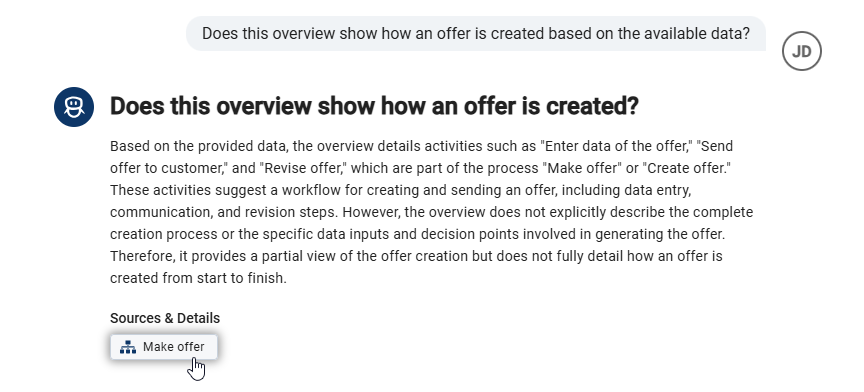
When you click a reference, the corresponding content opens in the same browser tab. When you navigate back afterwards, the chat history is restored. You then return to the previous location in the chat.
Hint
If no references are available, the reference section is not displayed.
How to talk to Arty
To receive accurate and precise answers from Arty, it is important to follow a few basic guidelines. Arty understands your input best when you formulate it clearly and explicitly state which information or results you need. The more specific your request is, the more effectively Arty can respond and support you in your tasks.
Tip
It can be helpful to reset the chat history when starting questions on a new topic. This helps to avoid influence from previous context and can improve the clarity and accuracy of the answers.
How should I model my processes for Arty?
To ensure that you receive the most accurate and helpful answers from Arty, there are several points you should keep in mind. If a single object contains a very large amount of information or too many attributes, this may confuse Arty and reduce the quality of the answers. The same applies to custom attributes you have defined and were set up by an administrator. If these are not named clearly, Arty may struggle to interpret their meaning. Very large processes, for example, processes with activities that have many (e.g., > 50) attached satellite files, may also prevent Arty from providing a complete answer.
Arty currently processes the following diagram types most reliably: BPMN diagrams, VCD, Application Context diagrams, and Business Capability Context diagrams and maps. Arty is familiar with the key elements of these diagram types because it can interpret the concepts of these notations. Arty can also evaluate other diagram types; however, this is done using a generic approach, which may result in greater variation in answer quality.
If you use terms that have different meanings in different contexts, this may lead to misinterpretations. In such cases, you should briefly clarify the context, choose a simpler formulation, or use an unambiguous alternative term so that Arty can correctly interpret your request. In addition, you should avoid combining multiple questions within a single message. Asking your questions one at a time allows Arty to respond more precisely and retrieve the relevant information more reliably. This helps Arty provide clear, complete, and accurate answers.
How should I phrase my questions for Arty?
For Arty to provide precise and helpful answers, your questions should always include the complete context. The more specific and self-contained a question is, the better Arty can understand it. A question such as “When does the Hiring process at the Berlin location expire?” is much easier to answer reliably than a shortened question such as “When does the process expire?”, which lacks the necessary reference to a specific process. If you want to clarify multiple questions, you should not combine them into a single message. Instead, ask each question separately so that Arty can clearly assign the information and determine the correct answer. Be sure to provide the full context with each question, as no chat history is stored.
Terms such as “production process” instead of “process” or “credit institution” instead of “bank” reduce misunderstandings and help Arty interpret your input correctly. Short explanations of context-specific terms or replacing ambiguous expressions with clear alternative terms can also help Arty understand your request correctly. This applies not only to questions in the chat but also to your modeling itself, as clear object and attribute names further support Arty’s responses.
Questions generally lead to better results than statements or purely descriptive text. Open or incomplete statements carry the risk that Arty might focus on aspects you did not intend or that important information may be missing. If you formulate your requests as precise questions, Arty can respond more accurately and provide exactly the information you need.
Tip
It can be helpful to use the term “process” in your question when you are asking about a specific process. For example: “Which risks does the Create Offer process have?” instead of “Which risks does Create Offer have?”. This helps Arty to better understand your request and provide more accurate answers.
How does Arty process the entered data?
Since Arty does not store any chat history, follow-up questions without repeated context cannot be answered reliably. For example, if you first ask “Who is responsible for the Hiring process?” and then follow up with “Which activities does the process have?”, Arty cannot correctly interpret the second question because it is unclear which process you are referring to. In such cases, you should always restate the reference so that Arty can interpret the information unambiguously.
Please also note that uploaded files or links within modeled processes cannot currently be taken into account. If you ask questions that refer to the content of attached files, Arty cannot evaluate this information.
Sequence information, such as the exact order of activities, events, or gateways in a modeled process, is also not currently included in Arty’s answers. Therefore, it does not matter how closely a model follows typical BPMN conventions. However, Arty can reliably answer questions about attributes stored on entities, such as the roles, risks, files, or links assigned to an activity. To avoid misunderstandings, you should always explicitly state the relevant process so that Arty can clearly identify which model your question refers to.